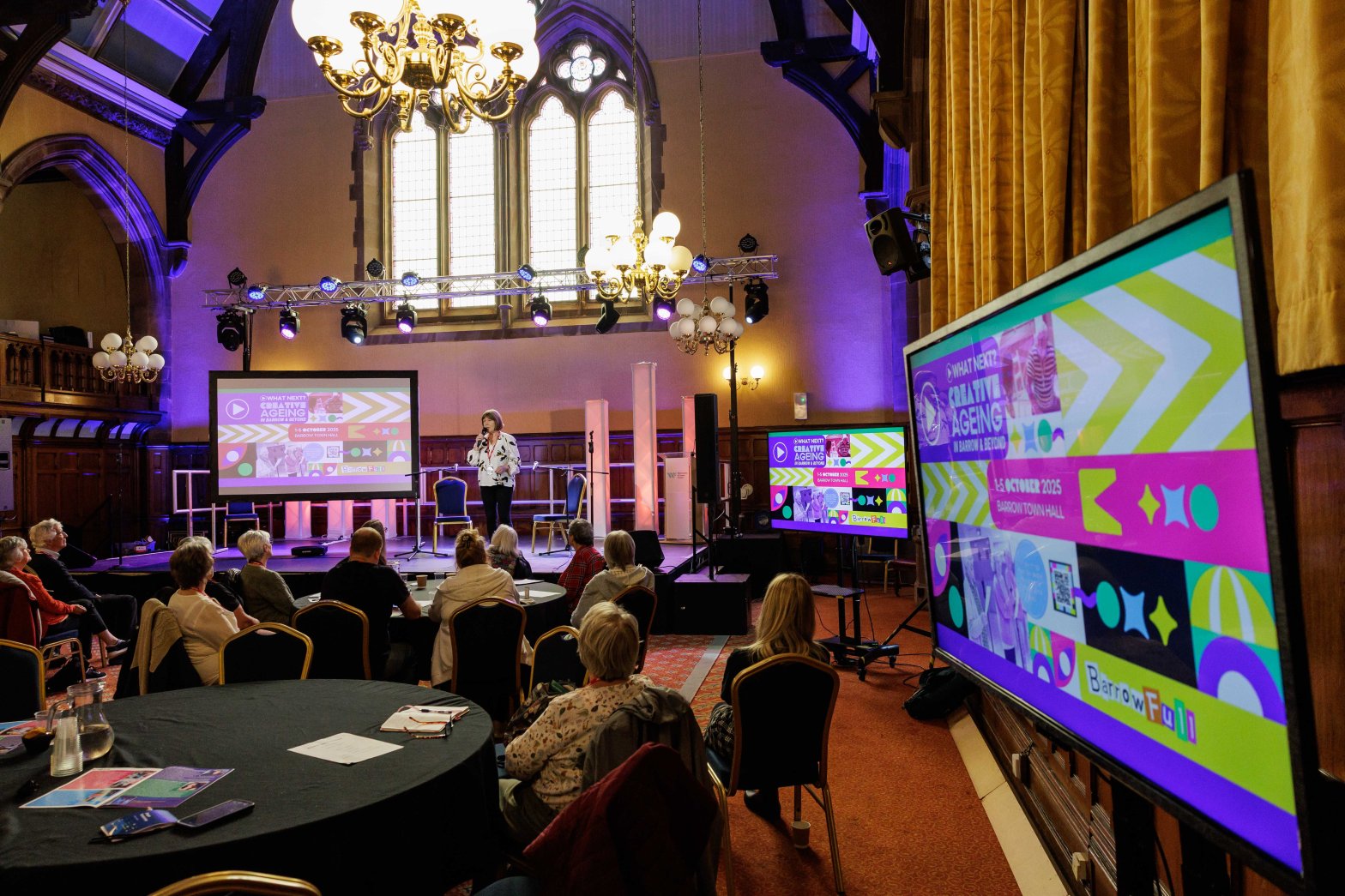
CADA Co-Chair Arti Prashar reflects on ‘What Next? Creative Ageing in Barrow and Beyond’, an event that brought together guests for two days of thought-provoking talks and vibrant entertainment. The day explored the future of arts engagement for older people including the vital and often under-recognised role of older artists themselves.
It’s fair to say I was quite excited to visit Barrow-in-Furness for the first time – curiosity really is my middle name! I’d always associated the area with the beauty of Cumbria and the wider Lake District, a place I’ve long loved (and where Kendal mint cake was a childhood favourite).
I’d been invited to Barrow to share a little about myself as an artist and to represent CADA. I’ll admit, talking about myself in public felt a little daunting. I can happily speak about creativity – but talking about me? That feels like stepping into vulnerability.
Daniel Tyler-McTighe is the Artistic Director of BarrowFull (an Arts Council England, Creative People and Projects Programme) and it was clear from the first moment we made contact that he is a very chilled and open person who leads a fabulous team. The phrase he lives by is “its informal, let’s just keep it informal”.
The evening before, all the presenters and performers were invited to a dinner – a kind of meet-and-greet before the big day. That’s where Daniel set the relaxed tone with his phrase: “Let’s just keep it informal – introduce yourselves to each other.” We did as we were told. Well-fed and watered, we got to know one another slowly and gently. It was the perfect start to the days that followed.
The celebration, titled ‘What Next? Creative Ageing in Barrow and Beyond’, featured a thoughtfully curated lineup of speakers and workshops held over several days. These workshops were co-designed with older Barrovians, ensuring their voices and experiences were at the heart of the programme. The celebration was delivered in partnership with Age UK South Cumbria and The Performance Ensemble.
Held on the International Day of Older People (1st October), each speaker brought something different to the day. The technology ran smoothly, and the atmosphere was warm and welcoming. Audiences gathered around tables, with screens placed throughout the space for easy viewing of presentations. Food and drink were available throughout, adding to the relaxed and inclusive environment.
We heard from Raisa Karttunen from Finland about the Armas Festival approaching their 10th year and the “Grand Old Man” graphic designer Erik Bruun who will be 100 years old next year. So BIG celebrations being planned for 30th March 2026 in Finland. Keep an eye out for that.
Professor Yoko Hayashi from Arts Alive! in Japan talked passionately about her visual art and dementia work in Japanese care homes. Much of her participatory work is evidence based and she’s encouraging facilitators to use art as a ‘social prescription’ to counter isolation and loneliness.
Maria Trost from Intergenerational Theatre-Making in Sweden shared with us the beautiful theatre, devised by a diverse company which includes refugees, LBGTQi+ people, young and older people. Maria spoke about wanting to make sure there was an ‘equal room’ so for example the usage of pronouns had to be navigated and that older people were not always given the ‘mentor’ role. It was a journey of trust and respect for those individuals involved.
There was then an interview with Bill Morrison; American comic book artist, writer, and editor of The Simpsons and Futurama. We would love to see a comic book that is just themed around older artists and people!
Throughout the day connections were made with old and new friends scattered across the UK and further afield. The whole day was punctuated with stunning poetic and beautiful performances from Alan Lyddiard’s The Performance Ensemble, older Barrovians and Indian temple dance by Sharmila Biswas and musician Kausik Dutta.
There’s something powerful about live theatre and dance. It elicits emotional response and connections – shared moments of fun and joy simply by being together in the same space. It reminds us that we are not alone, that we have much in common, and that right now, more than ever, we need to witness and show a way towards cohesive communities. A fractured society is a lost one. Here in the United Kingdom, we are a thriving multicultural and multi-religious society, where freedom of voice and expression are proud British values – values that must be protected.
In my presentation, I spoke about my concerns for “What Next” – for older people and for society more widely. I was essentially asking the audience and all older people to take ownership of this fight and to be inspired by the elders who sat in silent demonstration this summer in parliament square. We can’t just sit back and hope that someone else will take on the challenge. To bring people together and keep us united we must – as older people lead the fight.
It’s about understanding another human being from a different place to you – coming together through conversation and creativity, in an atmosphere of mutual respect and trust. It’s about defining the Britishness we want to belong to: a united nation that upholds its freedoms with grace, dignity, and acceptance.
We – older people, not old people are the largest demographic in the United Kingdom. With that comes responsibility: to consider the impact we can have on future policy and on society as a whole.
Yes, it’s complex. I don’t have all the answers, but I do believe that visibility, supportive networks, and participation in decision-making are vital. We are part of the fabric of British society. We must be seen and heard – for our experience, knowledge, wisdom, strengths and even our weaknesses.
We can influence positive change, now and for the future. How can we shape a British identity that embraces curry and chips, that celebrates Diwali, Eid, Hanukkah and Christmas, that recognises and reflects on our colonial history and class system and that uses culture and creativity to influence a greater understanding between us?
Ultimately, the question is: what unites us?
We are living in a time when it is more urgent than ever to come together, for the good of ourselves, our families, our communities and to celebrate both our differences and our connections. The culture of fear cannot be allowed to seep into our communities, or into our United Kingdom.
- Let us talk and disagree.
- Let us exchange stories and experiences across generations. Let us impart our wisdoms and histories.
- Let us dance together, let us sing together, let us create together, let us share food together.
- Let our laughter guide us.
- Let us as creative people show the way to a more peaceful world.
BarrowFull showed us that it is possible. It was a well organised and generous event, full of laughter with wonderfully informal moments in a most formal and magnificent setting of Barrow Town Hall.
It was inspiring to see our call for greater visibility of older artists being recognised as a positive force alongside older participants and practitioners who work creatively with older people.
Although I couldn’t stay for the following days, the programme sounded fantastic: workshops for older people in juggling, skateboarding, drumming, and Indian dance – go Barrow!
A huge thank you to the older people of Barrow for their warm welcome, and to the BarrowFull team for their vision and energy. Congratulations on securing another three years of ACE CPP funding – we wish you every success on your continuing creative journey.
 Creative Ageing: Development & Agency